2023 Royal Academy of Arts Summer Exhibition
Julian Hicks - Digital Photographic Art 2023
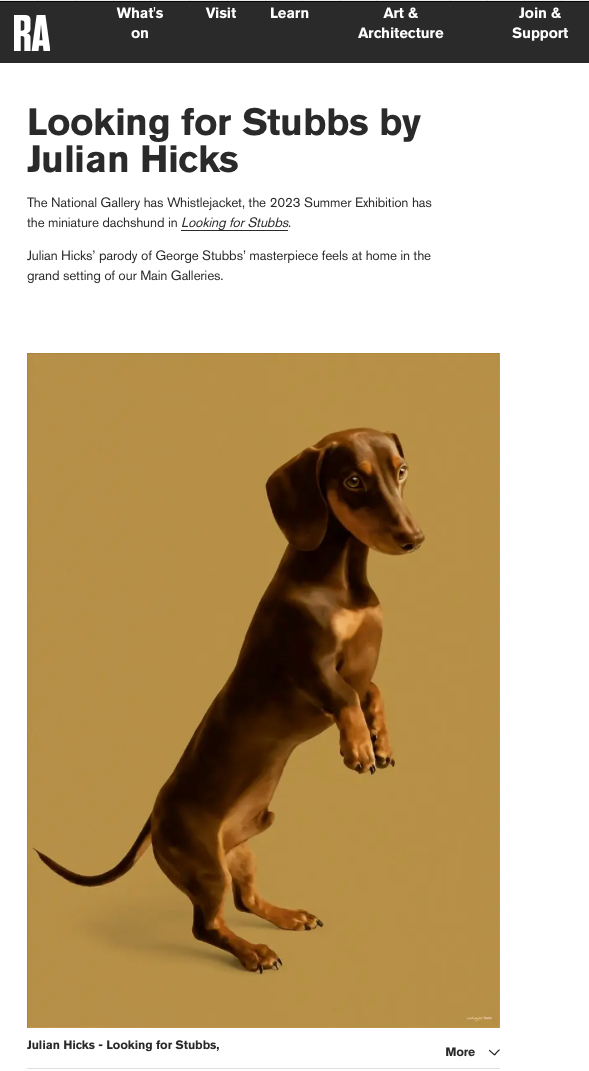
Looking for Stubbs
(limited edition print)
My wife Zehra has a print by Mark Wallanger, it’s Whistlejacket in negative with a unicorn horn called Ghost!
It’s on the wall in our kitchen so just about every day I have a visual connection with Stubbs.
‘Looking for Stubbs’ began on a day visiting London galleries with my friend and artist Peter Matthews. We saw the painting Whistlejacket and discussed me creating an art piece with my family’s sausage dog as the subject. Later in the year I remembered the conversation and took some photos of Vincent, persuading him to stand up for pieces of chicken that I’d attached to the end of a long stick. I shot as much as I could while Vincent's treats lasted. I got all the elements needed to begin the retouching. Building the dog from a few of the frames, searching to find the right ‘Looking for Stubbs'. In my image I’ve tried to use the softness that you see when close up to Stubbs’
‘Whistlejacket’, when you back away from Stubbs' painting, the subject appears to be totally sharp. Committee: David Remfry , Peter Barber, Eileen Cooper, Bill Jacklin, Katherine Jones, Tim Shaw, Clare Woods.
It’s on the wall in our kitchen so just about every day I have a visual connection with Stubbs.
‘Looking for Stubbs’ began on a day visiting London galleries with my friend and artist Peter Matthews. We saw the painting Whistlejacket and discussed me creating an art piece with my family’s sausage dog as the subject. Later in the year I remembered the conversation and took some photos of Vincent, persuading him to stand up for pieces of chicken that I’d attached to the end of a long stick. I shot as much as I could while Vincent's treats lasted. I got all the elements needed to begin the retouching. Building the dog from a few of the frames, searching to find the right ‘Looking for Stubbs'. In my image I’ve tried to use the softness that you see when close up to Stubbs’
‘Whistlejacket’, when you back away from Stubbs' painting, the subject appears to be totally sharp. Committee: David Remfry , Peter Barber, Eileen Cooper, Bill Jacklin, Katherine Jones, Tim Shaw, Clare Woods.
2020 Association of Photographers Awards
Blinkered
Finalist: Portrait. Open single stills
Judged by Anne Manion and Tim Flack
Judged by Anne Manion and Tim Flack
2019 Royal Academy of Arts Summer Exhibition
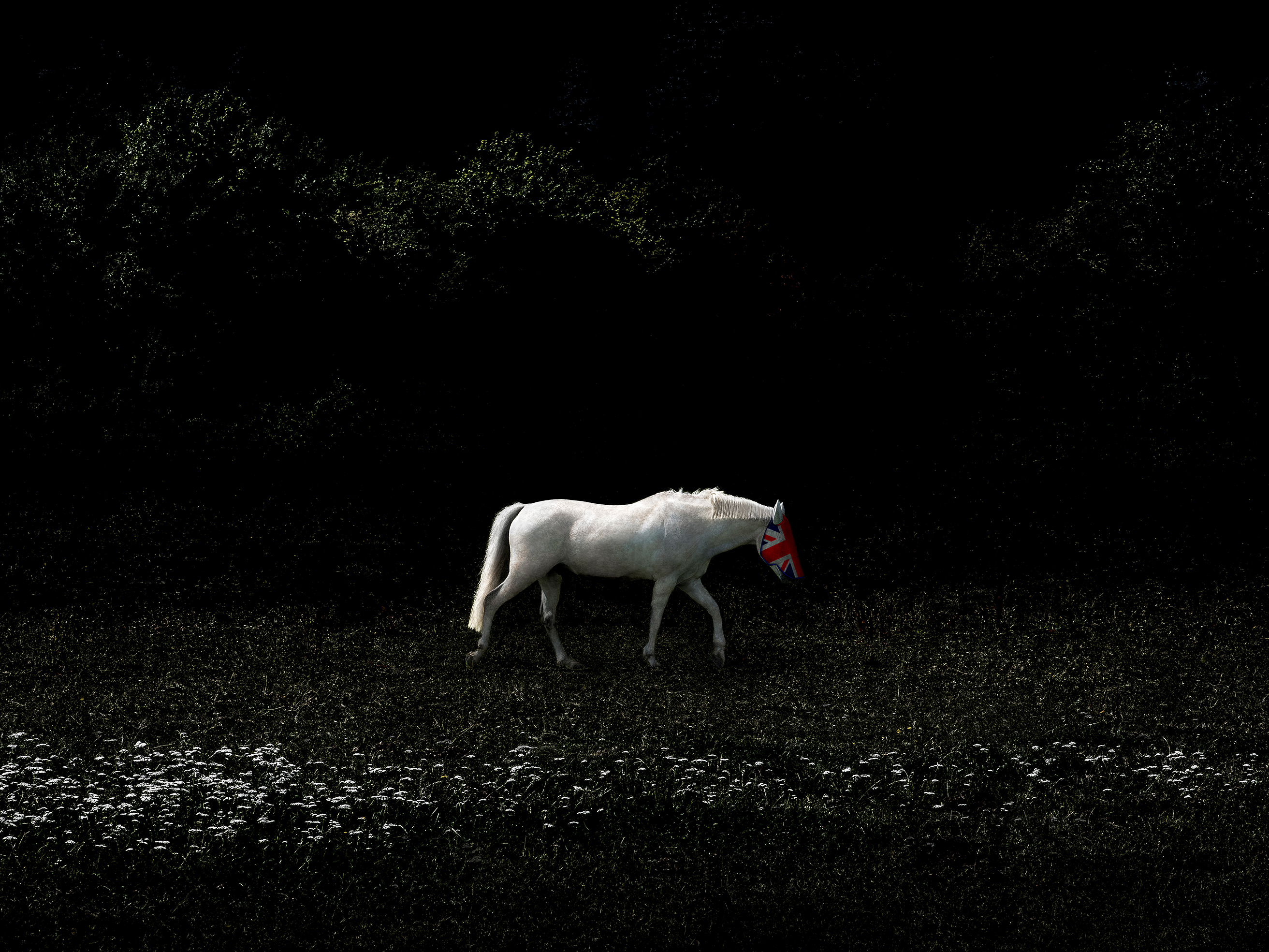
Blinkered (limited edition print)
A powerful white horse with its head covered by the Union Jack slowly passes through the landscape. The animals brightly lit tail is in focus while its head, consumed by nostalgia and in shadow leads us further into the ongoing darkness of the scene.
A powerful white horse with its head covered by the Union Jack slowly passes through the landscape. The animals brightly lit tail is in focus while its head, consumed by nostalgia and in shadow leads us further into the ongoing darkness of the scene.
Committee: Jock McFadyen , Jane and Louise Wilson, Richard Wilson, Spencer de Grey, Barbara Rae, Huie O’Donoghue, Timothy Hyman, Anne Desmet, Bob and Roberta Smith and Richard Chambers.
2017 Royal Academy of Arts Summer Exhibition
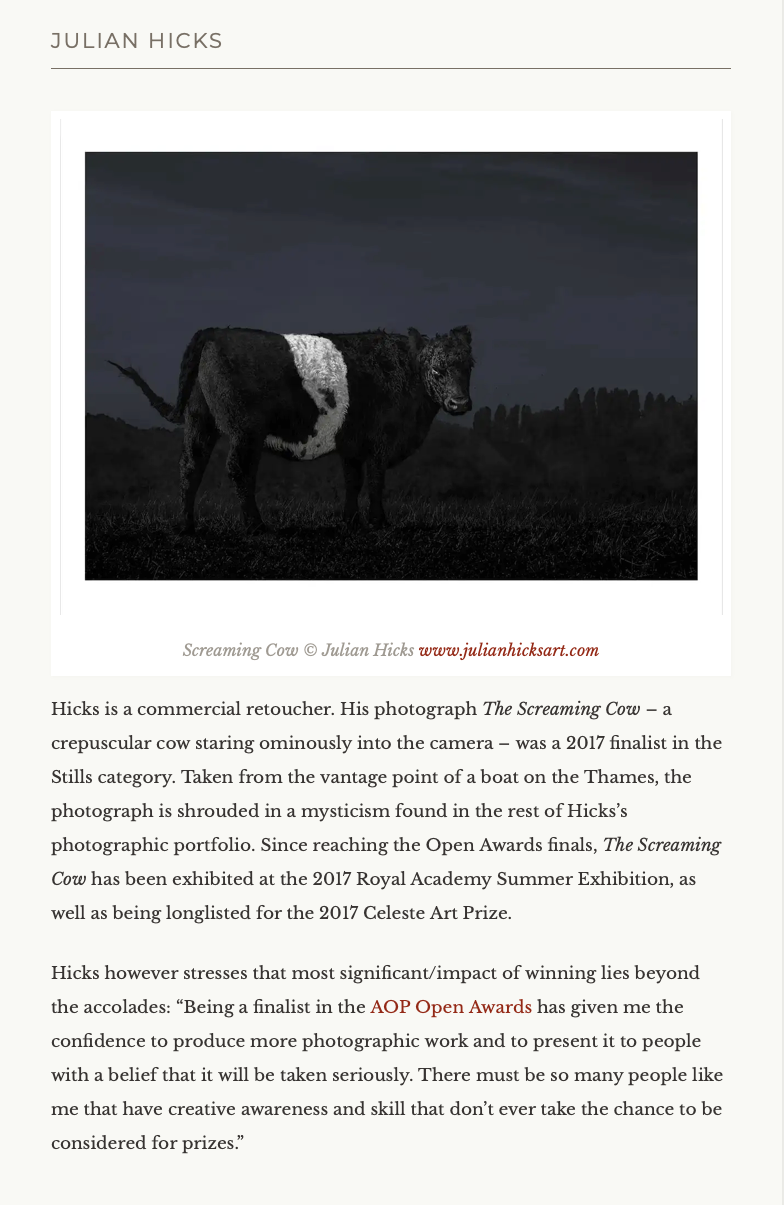
Screaming Cow
(limited edition print sold out)
Commitee: Yinka Shonibare , Ann Christopher, Eileen Cooper,
Commitee: Yinka Shonibare , Ann Christopher, Eileen Cooper,
Gus Cummins, Bill Jacklin, Farashid Moussavi, Fiona Rae, Rebecca Salter
Association of Photographers Awards 2017
Finalist: Screaming Cow. Open single stills
Judged by Phil Coomes, Photography Editor, BBC Online
Finalist: Screaming Cow. Open single stills
Judged by Phil Coomes, Photography Editor, BBC Online
2017 Celeste Art Prize
Screaming Cow
Longlisted: Screaming Cow
Chief-juror: Fatos Üstek
Chief-juror: Fatos Üstek
2016 Celeste Art Prize
Finalist & runner up: 7075. Photography & Digital Graphics
Curated by Ellen Blumenstein 2008-2025 1995-2008
Retoucher at various London design agencies.
Corporate Edge, CLK/MPL, ADC, Cann TV, DMG. 1989-1991 Kingston School of Art,
Curated by Ellen Blumenstein 2008-2025 1995-2008
Retoucher at various London design agencies.
Corporate Edge, CLK/MPL, ADC, Cann TV, DMG. 1989-1991 Kingston School of Art,
Higher National Diploma in Design.
1987 -1989 Reigate School of Art, National Diploma in Design.
1987 -1989 Reigate School of Art, National Diploma in Design.
British Journal of Photography
31 JANUARY 2019
Why enter the Association of Photographers’ Open Awards?
by ALICE FINNEY
The Association of Photographers’ Open Awards aims to shift the focus away from the photographer and instead celebrate the power of the image alone. Priding itself as an awards with a broad global reach, its most recent iteration saw some 3500 images submitted from various far flung corners of the world, from Finland to San Francisco. Entries came from hobbyists, professional photographers and everyone in between; instead of being influenced by a photographer’s professional industry accolades, the judges scrutinise the image as a standalone entity.
“Being a finalist in the AOP Open Awards has given me the confidence to produce more photographic work and present it to people with a belief that it will be taken seriously,” says 2017 finalist Julian Hicks. As a digital retoucher, Hicks felt that “most of the time [his] work was not recognised at an artistic level because [he is] not a professional photographer.” A celebration of excellence in photography from across the world, the Open Awards dismantles such barriers, reflecting the wider AOP’s ethos of ‘promoting, protecting and educating photographers of all levels’. The AOP was created 50 years ago by photographers and today it is still run by photographers for photographers. A not-for-profit, organisation, its all revenues go back into promoting photographers and creators.
Leon Fagbemi. Portrait shoot. Orpington. 15 May, 2016. © Tom Watkins www.tomwatkinsphoto.com
Photographer and filmmaker Dan Prince, a finalist from the most recent Awards, highlights the value of this inclusivity: “The Awards are a great platform for visibility within the industry as Open finalists exhibit alongside the main awards [the AOP Photography Awards and the Student Awards] which attract a lot of creative people,” he says. Finalists of the 2019 Awards will have their winning images showcased as part of a group exhibition at One Canada Square, Canary Wharf and will be rewarded with prizes including a £4000 Lumix kit voucher.
With the competition closing for entries on 25 February 2019, we spoke to four photographers – Katinka Herbert, Julian Hicks, Dan Prince and Fiona Read – about how they selected their winning submission and why the Open Awards were integral to their professional development. From a staged portrait to a candid shot taken in the wild, the range of submissions is notably varied. They can be seen as a microcosm of the wider entry pool.
–
Katinka Herbert
Joana Menédez Gonzalez © Katinka Herbert www.katinkaphotography.com
“Gazing at these bodies, we are forced to imagine the movements of which they are capable. The lives they wish to leave behind, and the ones that they dream of,” says Herbert, referring to her photo series on Cuban athletes. The Movers unveils the layers of inaccuracy surrounding Cuban representation and repositions the photographer’s subjects through her critical eye. The image that made her a 2017 Open Award finalist, Joanna, Tropicana Club Dancerdepicts a dancer, fully dressed in her performance costume, perched upright on the edge of her bed, stuck static within the confines of the bedroom walls and the even more rigid borders of the staged photograph. As a singular shot, it captures the overarching themes that tie the series together: the tension between mobility and domesticity, the black body as a “ticket to global mobility,” and the oppression of black movement both on and off the world stage.
Much like Prince, Herbert lauds the career-changing power of the awards: “the Open Awards offer great exposure across the industry,” she says. Since winning, The Movers has been exhibited at Photo London, the photography biennale at Somerset House and published in a number of high profile European magazines. Such exposure has further shed light and brought greater attention to the realities of life in Cuba.
–
Julian Hicks
Screaming Cow © Julian Hicks www.julianhicksart.com
Hicks is a commercial retoucher. His photograph The Screaming Cow – a crepuscular cow staring ominously into the camera – was a 2017 finalist in the Stills category. Taken from the vantage point of a boat on the Thames, the photograph is shrouded in a mysticism found in the rest of Hicks’s photographic portfolio. Since reaching the Open Awards finals, The Screaming Cow has been exhibited at the 2017 Royal Academy Summer Exhibition, as well as being longlisted for the 2017 Celeste Art Prize.
Hicks however stresses that most significant/impact of winning lies beyond the accolades: “Being a finalist in the AOP Open Awards has given me the confidence to produce more photographic work and to present it to people with a belief that it will be taken seriously. There must be so many people like me that have creative awareness and skill that don’t ever take the chance to be considered for prizes.”
–
Dan Prince
The Latvians © Dan Prince www.danprince.co.uk
With such broad submission guidelines how does one go about selecting what to enter? For Prince, the answer is simple: “Sometimes it’s the shots that you personally might not think are the strongest that make the Awards. You never know.” His winning submission, The Latvians was taken while on set for a photography commission. “These guys [his subjects] were actors in the TV advert. I wandered around the location and found a large window which was perfect. I asked them to to stand for a portrait and luckily, they agreed.” He encourages prospective entrants to take the plunge and “Just submit. Even if you have doubts, submit.”
–
Fiona Read
© Fiona Read www.fionareadphotography.com
Though the Open Awards is open to all, Read – whose portrait of her daughter featured in the 2017 Open Awards exhibition – stresses that serendipity alone does not make a winning entry. Rather, she suggests that a “compelling portrait is a truthful one, where the model is truly engaged with the moment.” Echoing the reflections of the photographers featured above, Read comments on the ripple effect the awards has had on her career: “Since then, I have graduated with a degree in Photography and have begun lecturing at the college I studied at. I have always loved portraits and working with people but this was a turning point for me and solidified that passion.”
–
The Open Awards is now open for submissions in the following categories: Stills, Moving Image and Innovation – a new category designed to encourage the use of new technologies. Submit your photography here. A curated exhibition of the winning work will take place at One Canada Square, Canary Wharf, London from 15 April – 31 May 2019.
This article has been written in partnership with Association of Photographers. Please click here for more information on sponsored content funding at British Journal of Photography.
Looking for Stubbs by Julian Hicks
The National Gallery has Whistlejacket, the 2023 Summer Exhibition has the miniature dachshund in Looking for Stubbs.
Julian Hicks’ parody of George Stubbs’ masterpiece feels at home in the grand setting of our Main Galleries.
The New Statesman
9 June 2023
The RA Summer Exhibition 2023: from the bland to the bravura
Visitors should come prepared: wear comfortable shoes, stay hydrated, put an energy bar in the pocket, and keep hope in their heart.
Photo by David Parry/ Royal Academy of Arts
How do you make sense of the Royal Academy Summer Exhibition? Both jamboree and jumble sale; both snapshot of the art that is really being made across the land outside the gallery ecosystem, and a cry for recognition by aspiring home painters. It has always been a bewildering affair in which amateurs measure themselves against professional artists, academicians and invitees, and it is, by its very nature, an exhibition about numbers as much as art.
The selection committee, this year under the painter David Remfry, was presented with 16,500 submissions by hopeful applicants. John Constable once had the indignity of sitting on the selection panel and hearing one of his own works dismissed by his fellow committee members as “a nasty green thing”. Contemporary committee members would be less than human if they didn’t bite back far worse.
The seven sage academicians looked at each submission – head tilted to one side, head tilted to the other – and gave about 15,000 of them the thumbs down. Nevertheless, the 1,613 works that have made it on to the RA’s walls are more than enough. Far more.
This year, as with every year, the visitor should come prepared: wear comfortable shoes, stay well hydrated, put an energy bar in the pocket, play an earful of calming whale song, and keep hope in their heart. Sensory cacophony beckons – installations of cloth, resin and handy detritus; paintings big and small hung eight deep; bendy ceramics and architectural models. All of this, apparently, answering to Remfry’s chosen theme for the year, the magnificently airy: “Only connect.”
But oh, the profusion. If the average, large monographic gallery exhibition contains, say, 100-120 pictures, how then to make sense of north of ten times that number? By watching out for eye-snaggers, perhaps, works crying out for a second and third look. There are not too many of those among the academicians, who seem to have interpreted “Only connect” as meaning only connect to the stuff they have been doing for years. Hence a cluster of Michael Craig-Martin’s soullessly immaculate outline pictures; a splat of same-old, same-old splayed Tracey Emins; a batch of underwhelming Joe Tilson paintings of tiles and tracery; some Yinka Shonibare-ish Yinka Shonisbares. All are put in their place by a showstopping installation by Paula Rego, who died a year ago. Her open cabinet – a sort of sinister polyptych or macabre Wunderkammer – contains a gathering of her fabric mannequins and painted panels to make a deeply unnerving mise-en-scène.New Statesman said this
There are plenty more. But the work I coveted was Henry Krokatsis’s time-stilling Chandelier No 4. It is a bravura exercise in tone, a black-and-white painting formed from smoke using votive candles which somehow manages to transmit both the blur and the sheen of the brass and candles of a church chandelier. And something more too: in the smoke that makes the picture are the remains of prayers. It offers a moment of quiet among the babble and, here at least, “Only connect” has meaning.